A hair tie spends much of its working life sliding across hair. A rough join, exposed elastic, or sharp decorative attachment can make removal unpleasant even if the tie holds well. Turn the entire loop through your fingers before using it.
Look for a consistent covering and a smooth connection. Some ties have a fabric seam, some are molded in one piece, and others use a glued or metal join. The construction alone does not tell you how it will feel; inspect the actual finish for rough edges or loose threads.
Enough turns without pulling hard
The useful diameter depends on the section of hair you intend to hold. A tie that needs too many turns may become cumbersome, while one that is nearly tight enough after two turns but painfully tight after three is not giving you a comfortable adjustment.
Try the intended hairstyle without yanking the loop into place. If you need to pull the hair tightly to make the tie stay, consider a different size or surface. A larger soft scrunchie may suit one arrangement and be too bulky for another.
Stretch is only half the comparison. After a gentle test, see whether the loop returns to a usable shape. A tie that has already developed a loose section or exposed core may be ready for replacement rather than another forceful stretch.
Remove it in reverse
Unwind the turns instead of dragging the entire bundle straight through a tight opening. This also makes it easier to notice a point where the join catches. If a decoration repeatedly tangles in hair, a simpler design may be more suitable for everyday use.
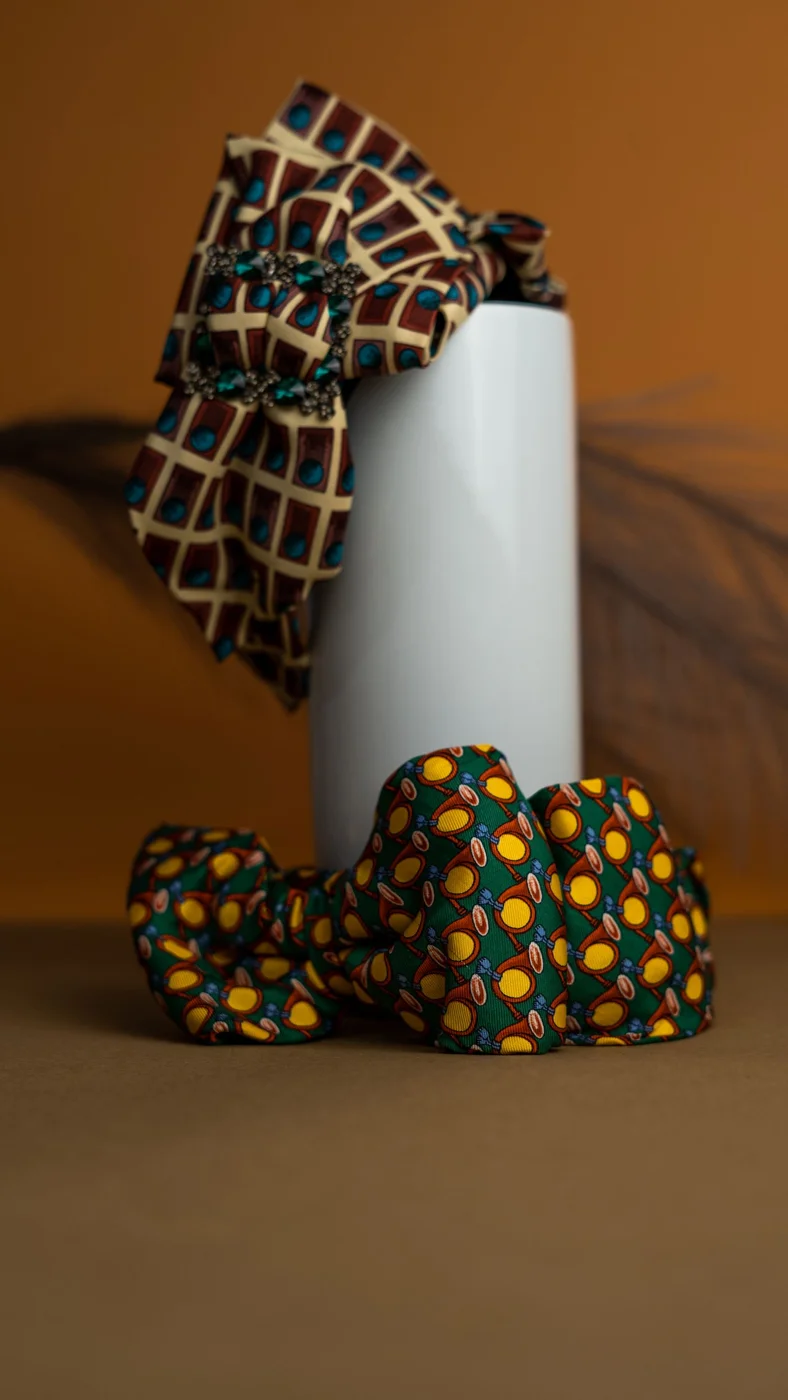
Think about the surroundings. A bulky knot can press against a headrest, and a dangling decoration may interfere with a collar or scarf. Check the complete combination rather than choosing a tie solely from a close-up photograph.
Cleaning requirements vary with fabric, elastic, and attached details. Follow the maker's guidance and allow a washable tie to dry before enclosing it in a bag. Do not assume a decorative tie can tolerate the same laundering as a plain fabric loop.
Keep a few ties that suit the hairstyles you actually wear, and retire ones with damaged coverings or exposed joins. A smooth, manageable fastening is more useful than a large pack of ties whose size or construction makes each removal a struggle.