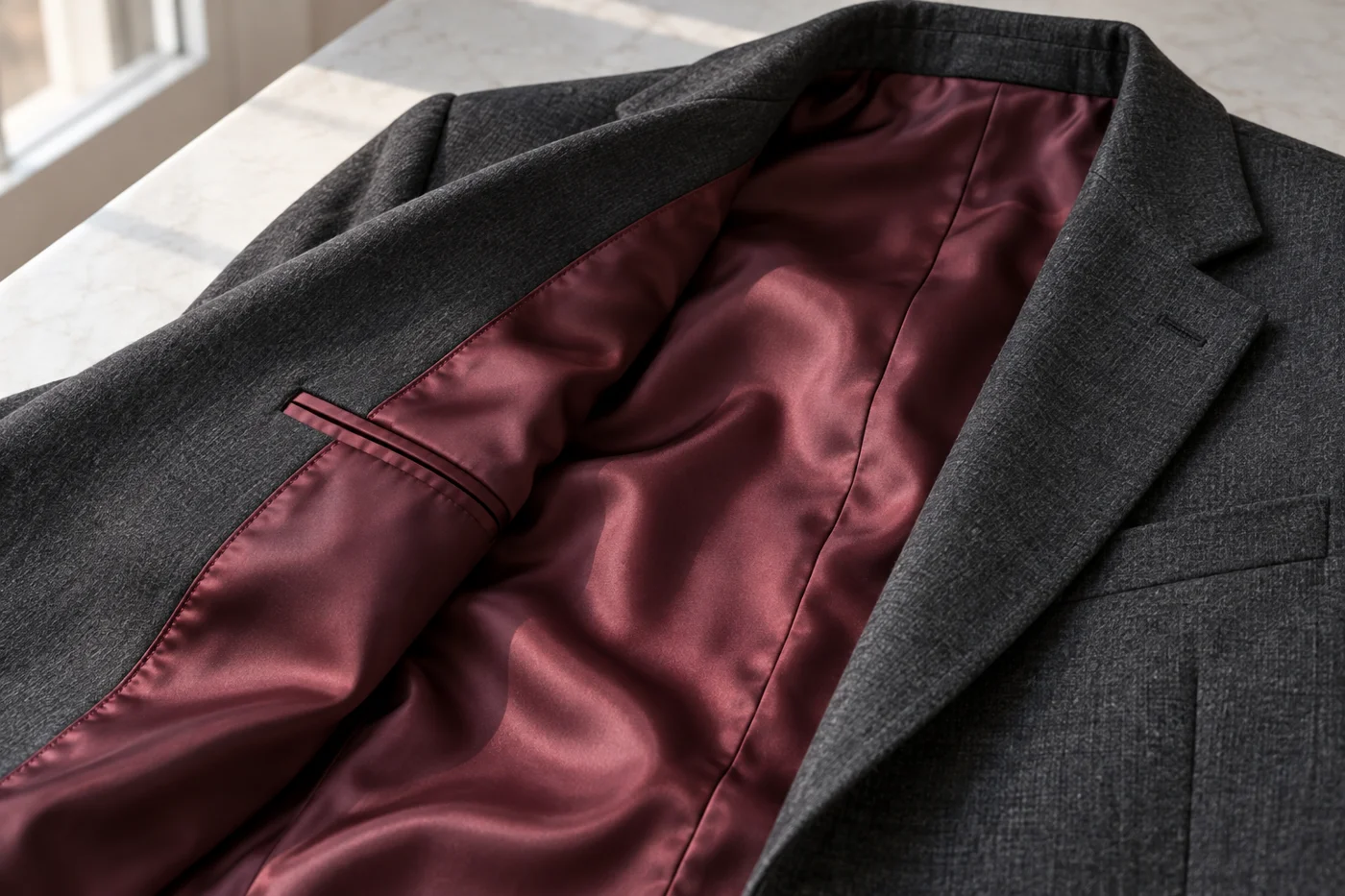
A jacket's outer fabric may have enough room while its lining pulls across the back. That can make the garment feel smaller than its measurements suggest. When trying lined clothing, assess both layers in motion rather than judging the exterior alone.
Wear the layer you expect underneath. A smooth shirt, textured sweater, and bare arm interact differently with a lining. Slide your arms into the sleeves and notice whether the fabric moves freely or bunches around the elbows.
Reach, sit, and return
Reach forward gently, then lower your arms. Check whether the lining settles back or holds the outer garment in a lifted position. For skirts and trousers, sit and stand to see whether the lining moves comfortably around the hips and thighs.
Look inside for twisted panels or obvious pulling at seams. Some garments include a fold or pleat to allow movement; do not assume that every loose-looking area is a defect. Equally, a lining stretched tight across a broad area deserves attention.
If the outer cloth stretches, the lining still needs to accommodate the intended movement. A flexible shell cannot compensate for an inflexible inner layer that is too narrow.
Length and coverage
Check whether the lining ends where intended. A skirt lining may be shorter than the outer hem, but it should provide the coverage you expect during movement. If it peeks below the hem unexpectedly, look for twisting or uneven hang rather than simply pulling it upward.
In a jacket, inspect the sleeve lining near the cuffs. It should not interfere with buttons or emerge awkwardly every time you put the garment on. Test the coat over your actual sweater to assess the complete combination.
Material information matters, but a lining's fiber name does not establish how smoothly it will slide over every outfit. Surface, construction, and the clothing beneath it all contribute. Read the separate lining entry on the label where one is provided.
Care applies to the complete garment. Do not choose a wash method based only on the outer fabric while ignoring a different lining or trim. If a tailor proposes altering the fit, ask how the lining will be adjusted as part of the work.
A good lining feels almost unnoticed during ordinary movement. It supports the intended garment without becoming the layer that catches, pulls, or decides where you can move.